Shading & dimension
Lo-fi retro 3D
The PS1 look kept on purpose: blocky texels, hard vertex lighting and dithering, with the CRT grain treated as part of the art.
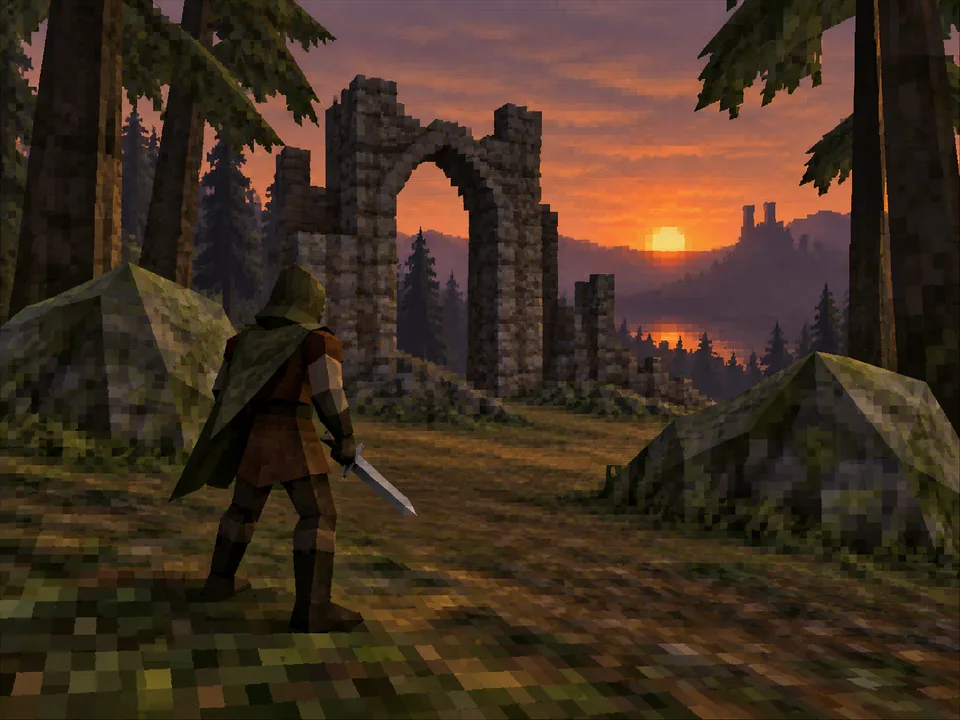
What to look at
- 01Texel blocks visible in every texture
- 02Hard vertex lighting, no smooth falloff
- 03Dithering and scanline grain left in
Prompts
The prompts stay in English on purpose: image models read English best, so translating them only costs you quality. Paste them as they are.
Character prompt
Goes in the Style field of the character, T-pose and animation tools.
late-1990s PlayStation 1 game character, crude low-polygon model with visible flat triangles, muddy 64x64 textures with big blocky texels, affine texture warping, hard vertex lighting, dithered limited colour, CRT scanlines, low 320x240 resolution
Tilemap prompt
Goes in the tilemap tool's custom style field.
late-1990s PlayStation 1 terrain, muddy 64x64 textures with big blocky texels, dithered limited colour palette, hard vertex lighting, CRT scanlines, low 320x240 resolution, no modern crisp detail
Background prompt
Generate a background image with this first, then feed that image to the scene splitter. Replace the bracketed part with your own scene.
A single 2D game background plate for [YOUR SCENE — e.g. a seaside village at dusk]. Horizontal composition, drawn as one illustrated scene whose buildings, trees, rocks and props sit clearly apart from one another, each fully visible and not overlapping, so every one of them can be cut out afterwards as a standalone asset. Draw it as a late-1990s PlayStation 1 game screenshot: crude low-polygon geometry with visible flat triangles, muddy 64x64 textures with big blocky texels, affine texture warping, hard vertex lighting, dithered limited colour, CRT scanlines and a low 320x240 resolution. Keep one consistent light direction and one consistent perspective across the whole scene. No characters, no text, no labels, no UI, no logos, no watermark, no border.
Games that made this look known
SIGNALIS · Dusk
Reference for your eye only. The prompts never name a game, so the model designs something of its own instead of copying one.
Keep looking
Use this style now
The prompts are free to take. Generating with them uses credits.